
Maya — Svenska for All • Kapitel-Arbetsblad
Casual Greetings & Everyday Social Life
Elevens namn: ______________________________ Datum: ______________
1. Inlärningsmål ("Jag kan...")
- ☐ Use casual and formal Swedish greetings with friends and colleagues.
- ☐ Ask someone how they are doing and reply naturally.
- ☐ Introduce myself and introduce others.
- ☐ Name items in everyday life (Vad har du i väskan?).
- ☐ Connect sentences using och, men, eller, för, utan.
- ☐ Form nouns in singular: obestämd (en/ett) vs. bestämd (-en/-et/-n/-t).
- ☐ Write a short personal text: "En text om mig själv".
2. Snabbguide & Grammatikregel
Coordinating conjunctions (och, men, eller, för, utan) join two main clauses without changing word order.
"The" is a suffix in Swedish: en bil → bilen, ett hus → huset.
Stress the information words (verbs, nouns), not pronouns: Jag heter ANNA.
The Swedish Suffix Trick: Don't look for a separate word for "the" in front. Just drop the front en/ett and glue the ending to the back! (en bok → boken; ett bord → bordet).
3. Övningar
A. Fyll i luckorna
- Hej! / ________ / Tjena! / Tja!
- God ________ / God kväll / God natt
- Hur mår du? / Hur är ________ / Hur är det?
- Bra, ________ / Helt okej! / Bara bra! / Inte så bra.
- ________ / Och du?
B. Sätt orden i rätt ordning
- Hur / Själv / tack! / Bra, / — / du? / mår
- Det / Sara / heter / Hon / kollega. / min / är / här
- Jag / inte / hinner / jag / men / komma, / vill
C. Skriv 3 egna meningar med kapitlets ord:
FOUNDATION • CHAPTER 2 • 20 MIN
Casual Greetings & Everyday Social Life
Learning Goals
- ✓Use casual and formal Swedish greetings with friends and colleagues.
- ✓Ask someone how they are doing and reply naturally.
- ✓Introduce myself and introduce others.
- ✓Name items in everyday life (Vad har du i väskan?).
- ✓Connect sentences using och, men, eller, för, utan.
- ✓Form nouns in singular: obestämd (en/ett) vs. bestämd (-en/-et/-n/-t).
- ✓Write a short personal text: "En text om mig själv".
The concept
Coordinating conjunctions (och, men, eller, för, utan) join two main clauses without changing word order.
"The" is a suffix in Swedish: en bil → bilen, ett hus → huset.
Stress the information words (verbs, nouns), not pronouns: Jag heter ANNA.
Examples
Hur mår du? — Bra, tack! Själv?
How are you? — Good, thanks! You?
Det här är min kollega. Hon heter Sara.
This is my colleague. Her name is Sara.
Jag vill komma, men jag hinner inte.
I want to come, but I don't have time.
Var är nyckeln? Den ligger i väskan.
Where is the key? It's in the bag.
A. Hälsningsfraser & Hur mår du?
Hej! / Hejsan! / Tjena! / Tja!
God morgon / God kväll / God natt
Hur mår du? / Hur är läget? / Hur är det?
Bra, tack! / Helt okej! / Bara bra! / Inte så bra.
Själv? / Och du?
Trevlig helg! — Tack detsamma!
B. Vad har du i väskan? (What's in your bag?)
en mobiltelefon
en nyckel / nycklar
en plånbok
ett pass
en dator
ett busskort
ett läppglans
tuggummi
D. Klockan — Essential Time Phrases
Hur mycket är klockan? / Vad är klockan?
Klockan är…
Hur dags…? / Vilken tid…?
Vid …-tiden
en kvart
en halvtimme
C. Att presentera andra (Introducing others)
Det här är min vän / kollega…
Han / Hon heter…
Vi känner varandra från…
Focus 1 · Huvudsatser & Konjunktioner (Coordinating conjunctions)
💡 Conjunctions join two complete main clauses without changing the word order. Both sides follow the V2 rule!
och = and · men = but · eller = or · för = because / for · utan = but rather (used after a negative)
- Jag dricker kaffe och han dricker te.
- Jag vill komma, men jag hinner inte.
- Ska vi ses idag eller ses vi imorgon?
- Hon stannar hemma, för hon är sjuk.
- Han dricker inte kaffe, utan han dricker te.
Focus 2 · Substantiv singular — Obestämd vs. Bestämd form
💡 In Swedish, "the" is added as a suffix to the end of the word!
En-words (utrum): obestämd en bil, en klocka, en penna → bestämd bilen, klockan (word ends in -a: just add -n)
Ett-words (neutrum): obestämd ett hus, ett äpple → bestämd huset, äpplet (word ends in a vowel: just add -t)
- en bok → boken
- en klocka → klockan
- ett bord → bordet
- ett äpple → äpplet
Focus 3 · Visual pronunciation — Vokalen 'A' & Satsbetoning
Långt A [a:] — vowel + one consonant. Mouth opens wide.
Kort A [a] — vowel + double consonant. Short, energetic punch.
Satsbetoning (sentence stress): stress the information-carrying words (verbs, nouns), not pronouns.
- Long: bra → "braa", dag → "daag", mat → "maat"
- Short: tack, katt, pass
- Jag heter ANNA. (stress on the name, not on jag)
3. Vad är klockan? (Telling the Time)
In Swedish, telling time is different from English once you approach the half-hour mark. Swedes look ahead toward the next hour!
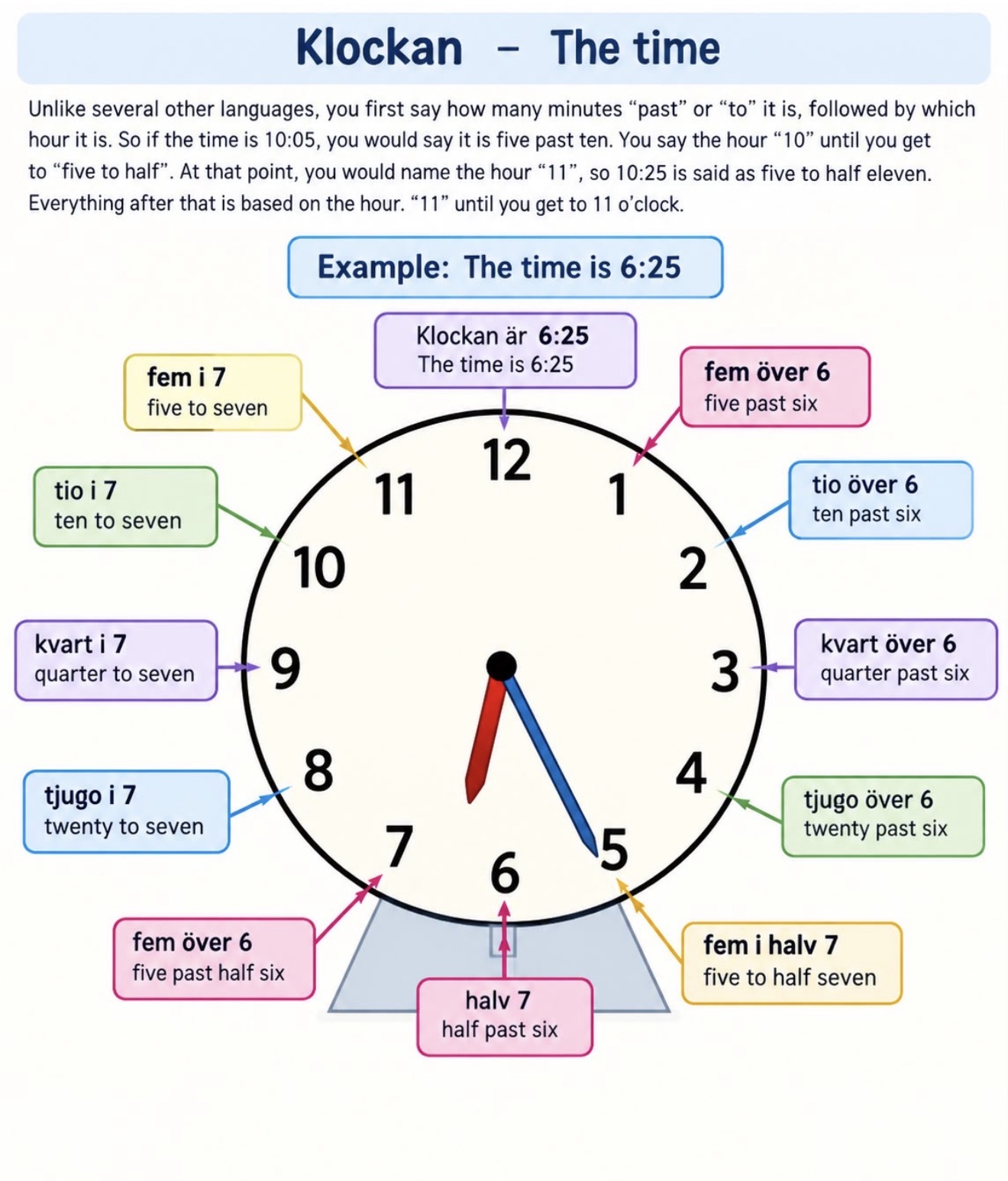
Move the sliders and the Swedish phrase below updates.
06:25
Klockan är fem i halv sju.
5 to half seven
💡 Anchor on the NEXT half hour: 5 BEFORE halv.
The two key prepositions
över = past / after (minutes 01–24)
i = to / before (minutes 36–59)
The "Halv" trap ⚠️
In English, "half six" often means 6:30. In Swedish, halv sju means "halfway TO seven" — that's 6:30!
6:20
tjugo över sex / tio i halv sju
20 past 6 / 10 to half seven
6:25
fem i halv sju
5 before half-way to 7
6:30
halv sju
halfway to 7
6:35
fem över halv sju
5 past half-way to 7
6:40
tjugo i sju
20 to 7
💡 The Half-Hour Anchor Hack
At :25 think "5 minutes BEFORE the next half hour" (fem i halv…). At :35 think "5 minutes PAST the half hour" (fem över halv…). Always use the NEXT hour number with "halv"!
Time Match Challenge
Click a digital time, then its Swedish expression.
Memory Hack
The Swedish Suffix Trick
Don't look for a separate word for "the" in front. Just drop the front en/ett and glue the ending to the back! (en bok → boken; ett bord → bordet).
Mini-quiz
Jag vill gå på bio, ____ jag har inga pengar.
Mini writing prompt
Write 4 lines introducing your best friend using "Det här är…".
- • Det här är min vän…
- • Hon / Han heter…
- • Hon / Han kommer från…
- • Vi känner varandra från…
Du har slutfört Kapitel 2!
Bra jobbat!